Public and Private Westminster...A London Walk
 On the second afternoon Ed was joining us in London, he and I (Victoria) did one of our favorite things -- took a London Walk.
We've taken many in previous years, but on Thursday, June 17, we chose Old Westminster, guided by David Tucker, a fellow Yank, whose knowledge of history and legend is -- well, legendary.
On the second afternoon Ed was joining us in London, he and I (Victoria) did one of our favorite things -- took a London Walk.
We've taken many in previous years, but on Thursday, June 17, we chose Old Westminster, guided by David Tucker, a fellow Yank, whose knowledge of history and legend is -- well, legendary.
The picture above at right was taken before the tour looking across Parliament Square with its ever-changing groups of protestors. This group opposed the current Afghan war. Big Ben stands at the northern end of the Parliament Buildings and the dark structure with the prominent chimneys is the relatively new Parliamentary office building. That is where we met David at the Westminster Tube Stop.
Above and left is the view from the river frontage of the Parliamentary Office Building, looking acrosse the Thames to the London Eye and the former County Hall, now a hotel, art gallery and aquarium. At right, a statue of Boudica, the English/Celtic Queen who tried to stop the Romans about AD 60. Various alternate spellings: Boudicca, Boadicea and others.
At the other end of the Westminster Bridge stands this coade-stone lion. This is another hint about that story of coade-stone I am promising to tell someday.
Looking at the river front of the Houses of Parliament from the Bridge, the House of Commons, its offices, library, etc. is on the right. The House of Lords is on the left.
David told us all sorts of interesting symbolism in the decoration and coloring of the buildings, but I will not steal his thunder by repeating every word (as if I could remember!).
On the street side of the building, Westminster Hall is quite prominent, many centuries older than the rest of the building, as it survived the great fire of 16 October, 1834, along with a few other parts of the Palace of Westminster, as the complex is properly known. The statue above someone's hands is of Oliver Cromwell (1599-1658).
J. M. W.Turner watched the Houses of Parliament burn and painted the scene. Reconstructions took from 1840 to 1870. The architect was Charles Berry, assisted by Augustus Pugin, their style was the popular Perpendicular Gothic.
 Here is an aerial shot showing the river frong, with the tower of Big Ben on the right and the tallest point, the Victoria Tower on the left (south).
 Back on the street, looking across at the ornate House of Lords crowned by the Victoria Tower on the right. If I turned around from this position I would be looking at the apse end of St. Margaret's Church, the church of Parliament, which stands rather in the shadow of Westminster Abbey.
 This file shot taken from the London Eye shows Big Ben and the edge of the Palace of Westminster on the left, looking southwest. The small white roof and church tower in the middle is St. Margaret's and the large building behind it is the Collegiate Church of St. Peter, commonly known as Westminster Abbey.
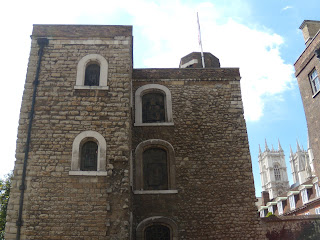 On our walk we crisscrossed the streets and proceeded south of St. Margaret's and the east end of the Abbey to see the Jewel Tower, c. 1365 in the reign of Edward III, aka the "King's Privy Wardrobe".
 At left, the apse end of the Abbey, toward the street across from the Palace of Westminster. The monument is George V (1865-1936). He became King upon the death of his father Edward VII in 1910.
 At the south end of the Palace of Westminster stands a lovely park called Victoria Tower Garden. This is a view of the Palace of Westminster is one I had never seen before.
 Emmeline Pankhurst (1858-1928) is honored with a bronze memorial in Victoria Gardens erected in 1930. She campaigned for women's suffrage, enduring several improsonments, but backed the government in WWI, causing a rift in the suffragist movement. Women gained the right to vote in Britian after the war.
I could not resist taking this shot of what apeard to me a whimsical structure in the Garden. Later I learned it is the Buxton Memorial Fountain, commemorating the 1834 emancipation of the slaves in the British Empire. In 1865 Charles Buxton, M.P. designed and erected it in honor of his relative Sir T. F. Buxton and others who worked with William Wilberforce to end slavery. The Fountain was conserved and rededicated in 2007, the two-hundreth anniversary of the end of the British Slave trade.

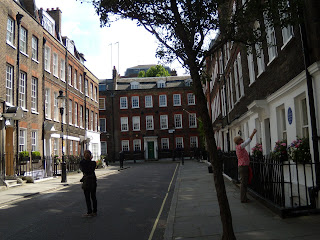 The private part of Westminster is found in the streets south of the Jewel Tower, where many Georgian houses are the scenes of political receptions and conferences.
 On the second afternoon Ed was joining us in London, he and I (Victoria) did one of our favorite things -- took a London Walk.


 Here is an aerial shot showing the river frong, with the tower of Big Ben on the right and the tallest point, the Victoria Tower on the left (south).
 Back on the street, looking across at the ornate House of Lords crowned by the Victoria Tower on the right. If I turned around from this position I would be looking at the apse end of St. Margaret's Church, the church of Parliament, which stands rather in the shadow of Westminster Abbey.
 This file shot taken from the London Eye shows Big Ben and the edge of the Palace of Westminster on the left, looking southwest. The small white roof and church tower in the middle is St. Margaret's and the large building behind it is the Collegiate Church of St. Peter, commonly known as Westminster Abbey.
 On our walk we crisscrossed the streets and proceeded south of St. Margaret's and the east end of the Abbey to see the Jewel Tower, c. 1365 in the reign of Edward III, aka the "King's Privy Wardrobe".
 At the south end of the Palace of Westminster stands a lovely park called Victoria Tower Garden. This is a view of the Palace of Westminster is one I had never seen before.
 Emmeline Pankhurst (1858-1928) is honored with a bronze memorial in Victoria Gardens erected in 1930. She campaigned for women's suffrage, enduring several improsonments, but backed the government in WWI, causing a rift in the suffragist movement. Women gained the right to vote in Britian after the war.

 The private part of Westminster is found in the streets south of the Jewel Tower, where many Georgian houses are the scenes of political receptions and conferences.
No comments:
Post a Comment