
Our tour's first stop was, fittingly, Number One London, the town house of the 1st Duke of Wellington, Apsley House. We arrived before public hours in order to take a private tour given by Christopher Small, who kindly agreed to let us photograph inside. He is a fount of knowledge on the Duke and the Museum, an excellent guide to everything we wanted to know.
For the Apsley House wsebite at English Heritage, click here.
The website has an excellent timeline on the history of the house from its original construction by architect Rovert Adam (1728-92) in 1771 for Henry Bathurst, Lord Apsley, to its present day status as The Wellington Museum.

Painting of Apsley House, 1770's
Our post on the 2014 renovations at Apsley house is here.

First Christopher took us to see the many gifts and awards the Duke received from grateful governments and monarchs. Here are just a few from the several rooms full of treasure.

Field Marshal's Batons: decorative accolades from allied nations

The Prussian Service, with Arms of the Duke of Wellington, 1819

Silver-gilt candelabra
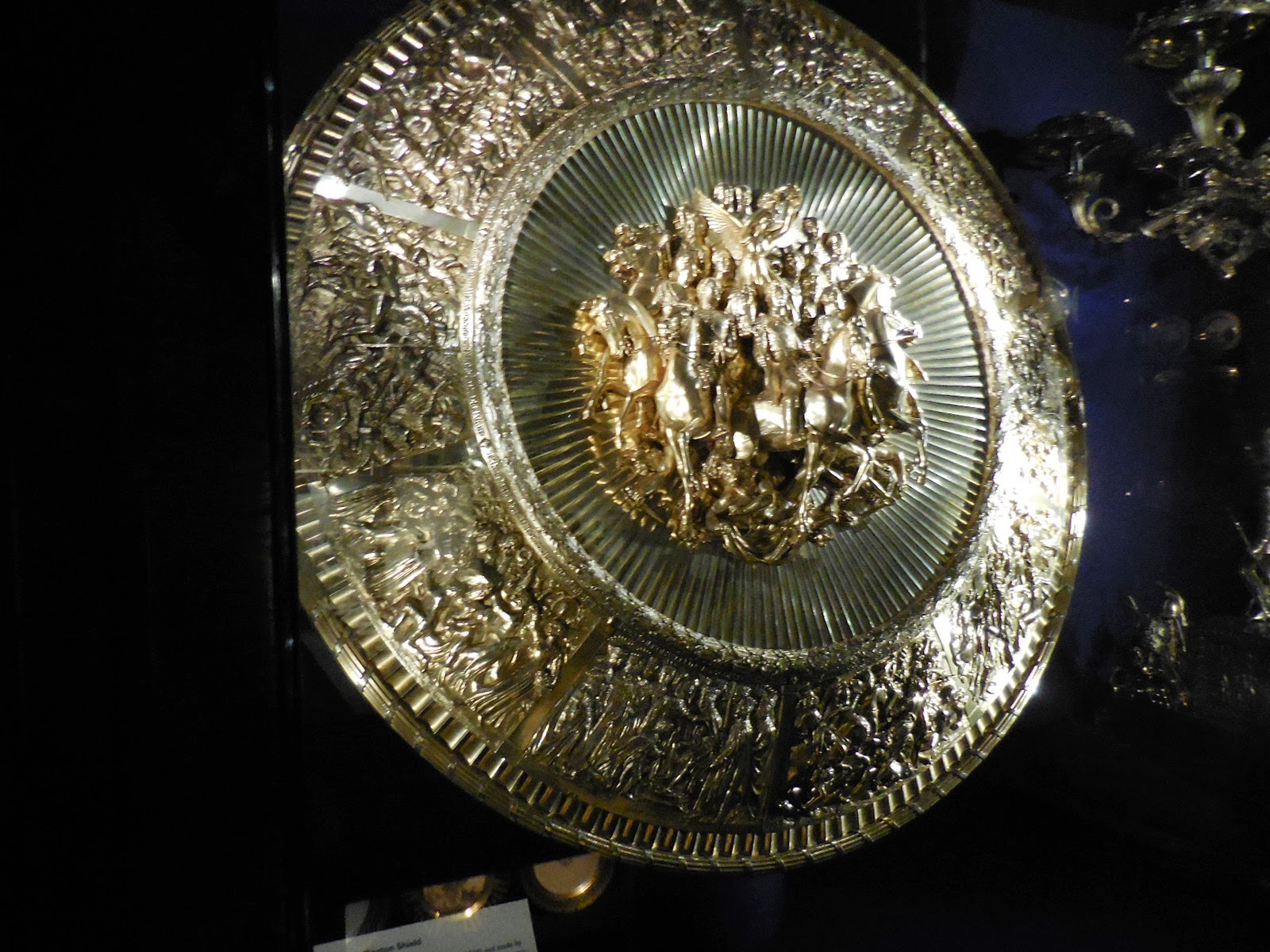
The Wellington Shield, designed by Thomas Stothard,
made by Benjamin Smith 1822

Vase from the Prussian Service, 1819

The Saxon Dinner Service
Coming Face to Face with the gigantic statue of Napoleon by Canova, one is amazed first by its size, then by its placement in Apsley House (home of Napoleon's conqueror), then by the complete lack of resemblance to what we know of Napoleon's physique: short and stout, -- and with no vest into which he could insert his hand.


Click here to read about Victoria's visit in 2011 and what happened when her husband saw it.
The graceful curving staircase is part of the original Adam design. On the principal floor (up one flight) there are four drawing rooms, the State dining room, and the Waterloo Gallery..

chandelier in the Piccadilly Drawing Room

Piccadilly Drawing Room Fireplace by Robert Adam
According to the text panel, the Piccadilly Drawing Room was designed in 1774 by Robert Adam; his fireplace, frieze and ceiling ornament remain.

Apse of the Piccadilly Drawing Room

Adam Ceiling of the Portico Drawing Room

Yellow Drawing room, above and below

The Striped Drawing Room was adapted by Benjamin Dean Wyatt in the 1820's from a bedchamber and dressing room in the original Adam plan.


Striped Drawing Room; side table with bust of Prime Minister Spencer Percival

Bust of Prime Minister William Pitt the Younger (and reflection of Marilyn)

State Dining Room
The dining room was added to the Adam building for the Duke in 1819 by architect Benjamin Dean Wyatt. Also included in the addition were bedrooms and dressing rooms, not on display.

The Portuguese silver gilt service stands as a centerpiece on the dining room table. It was made in Lisbon about 1816 and presented to the Duke for his preservation of Portugal.

Our excellent guide, Christopher Small,on the left.

The Waterloo Gallery was a second addition to the original Adam structure, built again by Benjamin Dean Wyatt (1775-1852) in 1828, after the Duke had become Prime Minister. At about 92 feet in length, it provides elegant space for dinners, receptions, and the display of the extensive art collection, about which we shall report soon.


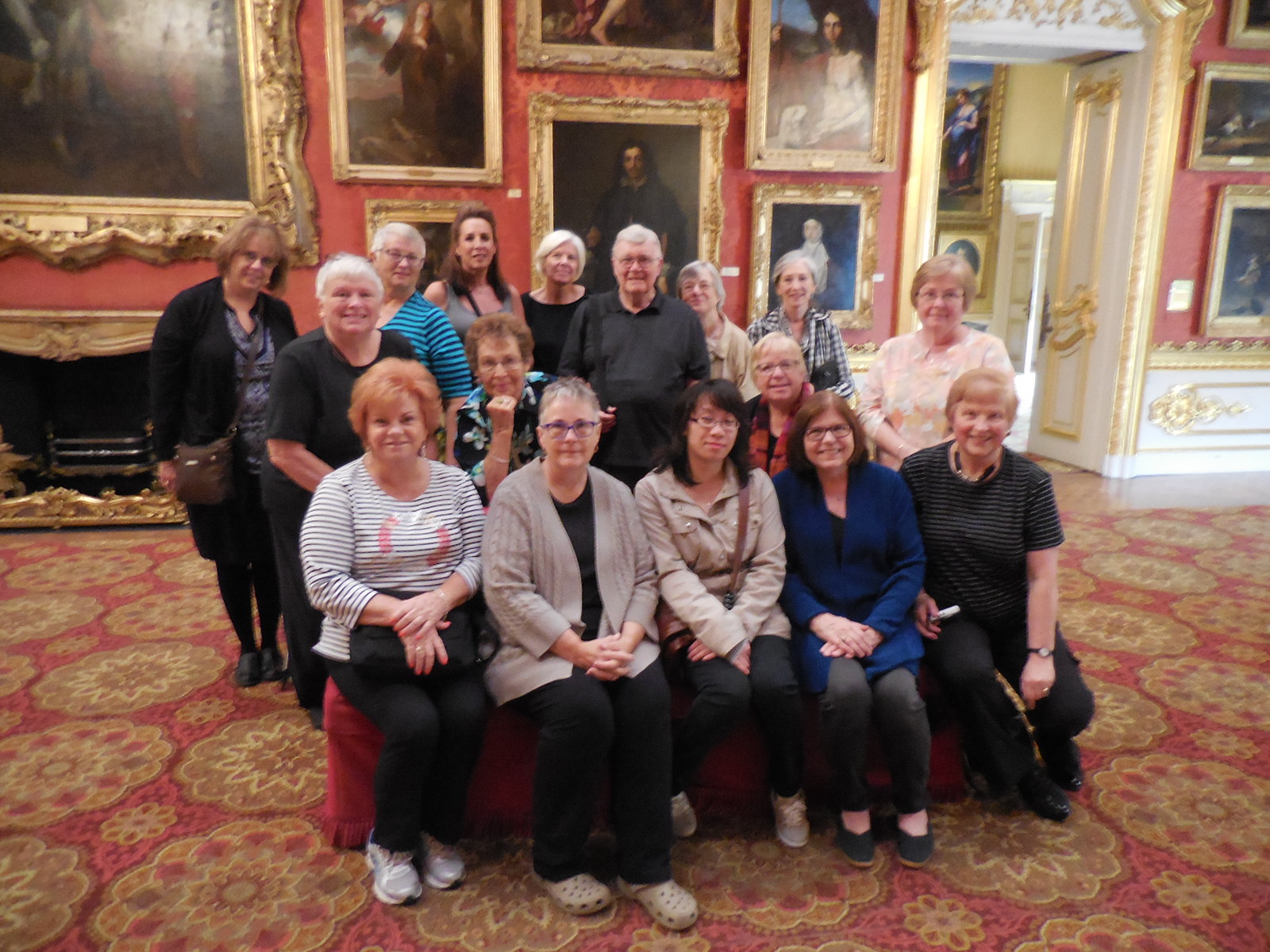
The intrepid Duke of Wellington tour group
Below, several glass cases held possessions of the Duke and his family.

On the right above, the Duchess of Wellington's silk Key Bag

1850 New Year Card from Queen Victoria to Elizabeth, 2nd Duchess of Wellington

1st Duchess of Wellington' s Diary

1815 miniature, thought to be of Kitty, 1st Duchess of Wellington at age forty

The upper hair is from Copenhagen, the Duke;s charger;
below, a small piece of Copenhagen;s mane
For more reports on The Duke of Wellington Tour at Apsley House, September, 2014, please stay tuned.
Sigh. I want to go back!
ReplyDeleteAccording to the British physician who led the post-mortem examination, Napoleon's height was 1 meter and 70 centimeters. Not exactly short by the standars of his time.
ReplyDeleteHe was 51 years old when he died, almost 30 years after being in his twenties with a physique totally opposite to being stout.
All it takes is a few minutes to see, via Google, his pictures at e.g. the Battle of Arcola..........
Maria - 5' 7" was certainly not tiny for the day. Wellington himself stood between 5' 9 and 5' 10. No doubt Napoleon was fighting trim in his younger days. However, in the context of Waterloo, people tend to remember Napoleon as he was depicted then, rather than as a triumphant young warrior holding aloft a flag whilst seated atop a rearing white horse. Likewise, Wellington will always be thought of as he looked at the time of Waterloo, rather than as the white haired and slightly stooped elder statesman he became afterwards. Alas, history is kinder to some than to others.
ReplyDelete